
Applying business strategy and psychology to cure workplace dis-ease.
With Change Comes Risk
Periods of rapid growth, integration, restructuring, or leadership transition place significant strain on an organization’s culture. As priorities shift and pressure increases, clarity erodes, expectations blur, and informal norms begin to fray.
These early fractures often show up quietly — in how people communicate, make decisions, and treat one another. Left unaddressed, they weaken trust, disrupt performance, and create conditions where workplace incivility can take hold and spread.
This is how culture risk begins — not through a single breakdown, but through everyday moments that go unnoticed until the impact becomes harder to ignore and manage.
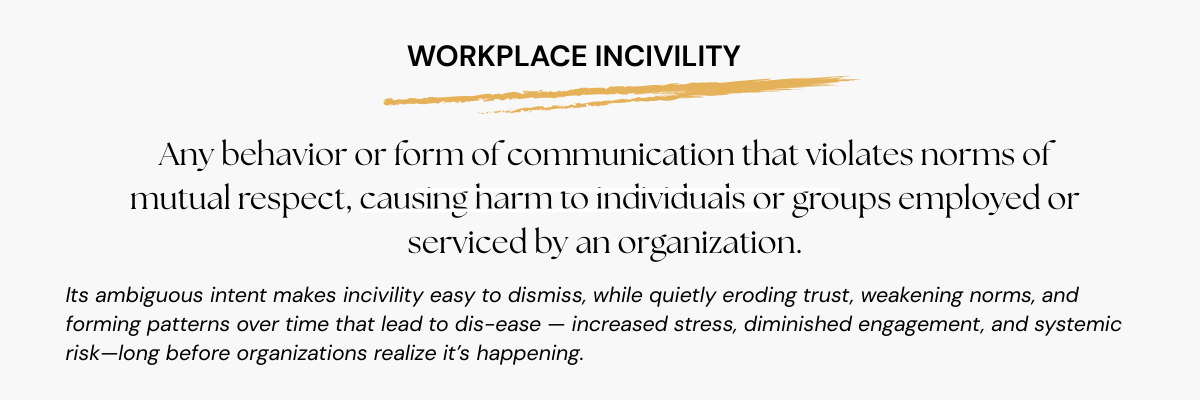
Because workplace incivility is nuanced, difficult to name, and rarely addressed with consistency, leaders often lack a clear path for recognizing it early or responding effectively before it spreads and causes systemic harm.
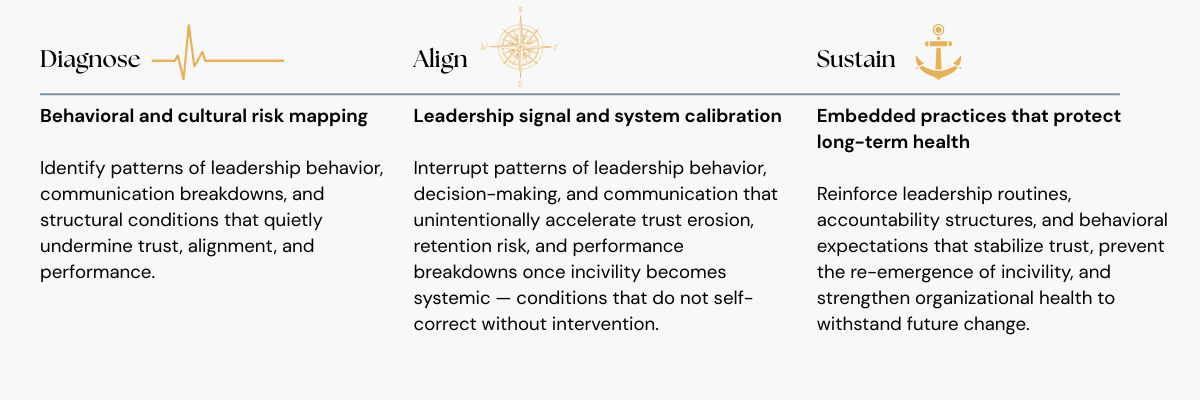
We partner with leaders to strengthen systems, guide behavior, and reduce organizational risk before incivility becomes self-reinforcing. Here’s what our process looks like:
If culture is top of mind, or your organization is navigating a major shift that will impact your culture, we'd love to talk to you.
Symptoms of Workplace Dis-Ease
When organizational health declines, the warning signs aren’t always loud — but they are costly.
Behavioral “micro-fractures” start small: missed signals, frayed trust, slowed decisions. Over time, they spread through the system, affecting performance, retention, and resilience.
Most organizations see one or more of these symptoms before calling The Civility Doctor:
-
Information slows. Assumptions replace clarity. People stop saying what they really think.
➡ Trust weakens quietly.
-
Norms feel inconsistent. Teams pull inward. Collaboration takes more effort than it should.
➡ Alignment starts to fray.
-
Roles expand faster than expectations. Decision rights blur. Accountability feels uneven.
➡ Confusion becomes chronic.
-
Managers are promoted faster than they’re supported. Coaching, feedback, and intervention fall behind.
➡ Pressure rolls downhill.
-
Energy drops. Cynicism rises. People disengage—but stay.
➡ Retention risk increases.
Left untreated, these patterns escalate into measurable financial and human capital losses - performance, retention, and trust.
That’s where early diagnosis matters: identifying the structural causes beneath behavioral symptoms before they become a larger culture risk and threat to overall organizational health and well-being.
Recognize your organization in any of these symptoms? Learn how we can help.
The Cost of Ignoring or Underestimating Impact

Incivility is often treated as a behavioral issue to manage rather than a business risk to mitigate. When it goes unrecognized or is handled inconsistently, its effects extend beyond culture into day-to-day operations and long-term performance.
What often begins as minor behavioral strain can quietly compound into material costs—draining leadership capacity, weakening performance, and increasing exposure long before the impact is recognized.
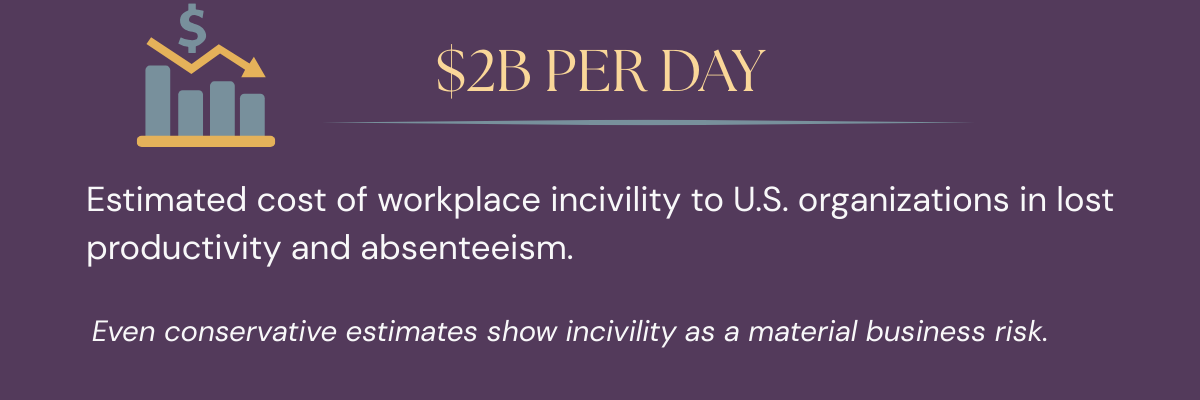
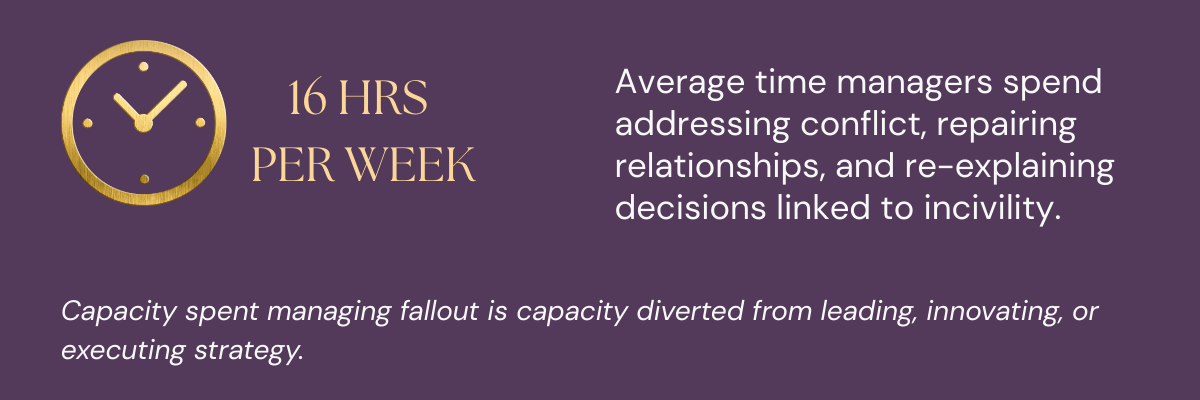
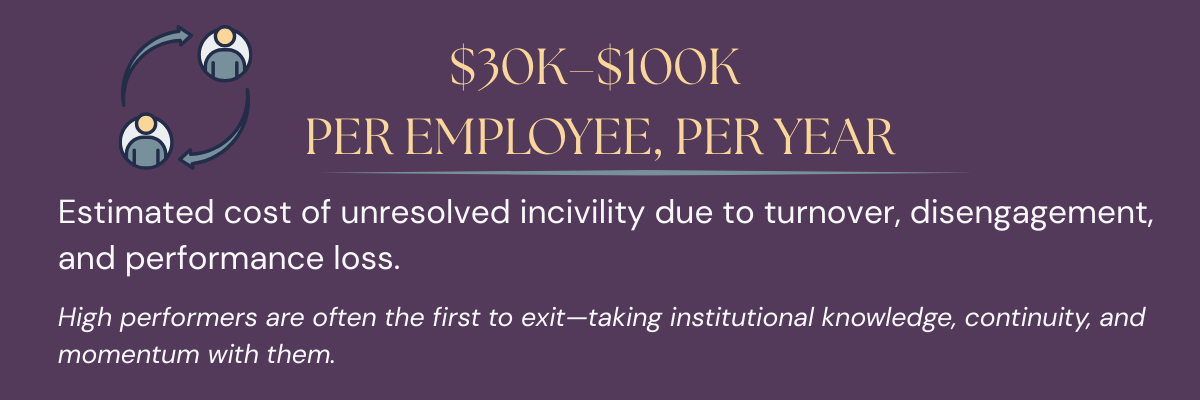
Left untreated, incivility becomes a hidden infection—one that spreads across teams, degrades performance, and slowly increases culture risk. By the time outcomes are visible, the cost of repair is significantly higher than the cost of early intervention.
When the human body experiences illness or trauma, every system is affected. Prolonged strain compromises its ability to recover. Organizations are no different. During periods of sustained pressure or misalignment, cultural systems weaken, relationships destabilize, and performance becomes harder to sustain.
The Civility Doctor relies on two decades of applied research showing that civility is not etiquette or tone management — it is infrastructure. It is how leaders signal clarity, reinforce accountability, and create conditions for trust to hold under pressure.
Finding the Cure
Our work applies business strategy and behavioral science to strengthen the systems that sustain workplace civility — leadership routines, communication pathways, and decision practices. When these systems are aligned, organizations are better equipped to stabilize performance, reduce risk, and withstand future disruption.
Discover how we identify and treat the root causes.
Civility is the mechanism that keeps leadership intent, culture, and performance aligned when pressure rises.

-
![]()
Only 16 % of employees are thriving in their roles worldwide, signaling massive room for performance, engagement, and civility interventions.
-
![]()
Workers in positive cultures are 4 × more likely to stay and 3 × more likely to recommend their employer.
-
![]()
26% of U.S. workers have considered leaving their jobs due to incivility. This number is steadily increasing.


Leaders accountable for culture, change, or risk management operate under significant pressure to keep organizations stable—especially during major change events, when the risk of cultural and performance decline is highest. These moments test alignment, trust, and resilience.
Using the lens of civility is a validated driver of organizational health and well-being.
Reduce Risk. Transform Culture. Stabilize Organizational Health.
Partner with The Civility Doctor
Workplace dis-ease takes hold when accumulated strain, misalignment, and unclear leadership signals go unaddressed.
Addressing it requires more than good intentions. It requires infrastructure that stabilizes behavior, culture, and performance through change—reducing the likelihood of costly breakdowns over time.
Whether the goal is recovery or readiness, civility as infrastructure does more than correct isolated behaviors. It creates systems that sustain clarity, accountability, and resilience through disruption.
Are you ready to explore how we can help you navigate change and protect organizational health?
Start Healing Today!
Book a free discovery call to learn how we can help you diagnose, treat, and stabilize your organizational health.

Subscribe for Exclusive Insights
We practice email etiquette and will not spam your inbox. Thanks for subscribing!